STATE OF THE UNIONS South African trade unions at the crossroads
Development is, foremost, dependent on how much you get out of the one resource that is truly under your own command and control-namely, yourself.
Peter Drucker
Part of the journey
I started working with, and against, South African trade unions in the late 80s, as a brand new lawyer. In pre-democratic South Africa, unions were simply synonyms for “Communists” and all sorts of other name-calling in some of the circles I moved in. Our labour law was, to me, a thing of great beauty, a place where finance, law and workplace conflict tried to find a way where every puzzle piece could fit, a place where human nature and human dignity could balance the books on a fair playing field. Those rosy ideals were, to some extent, knocked out of me rather early on, but some of it remained.
Those early days of debating and arguing complex issues, working and traveling together, often enough finding solutions to seemingly intractable conflicts all made me believe that we were on a positive trajectory, that time and hard work would get us where we all wanted to be. Those ideals also caused tremendous frustration and disappointment over the years, and they still do. If back then you asked me where we would be as a country in late 2026, this would certainly not have been my answer.
So, it is with that changing set of expectations, that lived experience that I write this article. It is a highly personal reflection, and my criticism comes from that personal place, a place where disappointment and hope still, even now, live side by side.
A movement that forgot its trade
South African trade unions are not dying. They are doing something more dangerous: they are surviving on the wrong things. They still have legal muscle, a seat at NEDLAC, a guaranteed audience in Luthuli House and, in the public service, some of the highest union density in the democratic world. What many of them have lost is the craft that made them formidable in the first place: the patient, skilled, unglamorous work of organising people, representing them well and resolving conflict on the shop floor.
I have worked with unions for most of my professional life, first across the table as a labour lawyer and later as a conflict practitioner. I hold no brief for the lazy argument that unions are an obstacle to growth. The labour movement is one of the few institutions that can claim, without exaggeration, to have helped bring down apartheid and write the rules of the democracy that followed. That history earns respect. It does not earn exemption from scrutiny.
The argument of my article is simple. The movement's political journey brought real and lasting gains. The same journey also drew its best people, its attention and eventually its identity away from the workplace and into the corridors of the state. The membership has shifted from mines and factories to classrooms, hospitals and government offices. Meanwhile, on the private-sector floor where most South Africans now work, unions are increasingly absent, or present in name while the actual handling of conflict has passed to the CCMA, to HR departments and to labour brokers' lawyers.
What follows is a conflict analysis, not a eulogy. I would even plead guilty to a slightly pro-union bias. It traces how the movement got here, what the numbers actually say, how South Africa compares with unions abroad that have adapted and those that have not, and what a return to the craft would demand. In looking at as much objective data as I can, I hope to arrive at as fair, but also as practical, an assessment as I can manage.
The political journey: from shop floor to state
The modern movement was built from the factory floor up, and that origin matters for everything that follows. The 1973 Durban strikes showed that black workers without legal recognition could still bring production to a halt. The Wiehahn Commission's reforms of 1979 brought black unions into the statutory system, largely in the hope of taming them. The opposite happened. The Federation of South African Trade Unions (FOSATU) built its strength on elected shop stewards, worker control and plant-level recognition agreements, often fought for case by case. Its organisers were, above all, technicians of workplace power. COSATU was launched in Durban on 1 December 1985, merging the FOSATU tradition with the unions aligned to the Congress movement.
Within two years it had adopted the Freedom Charter, and the long argument between "workerists" (who wanted an independent working-class politics) and "populists" (who saw the unions as part of a broader national liberation front) was settled in favour of alliance. When the ANC was unbanned, that alliance was formalised as the Tripartite Alliance of the ANC, the SACP and COSATU. The moment of 1994 was the high-water mark. COSATU drafted the first version of the Reconstruction and Development Programme. Former union leaders walked straight into Parliament and the Cabinet: Cyril Ramaphosa from the NUM, Jay Naidoo from COSATU itself, Alec Erwin from NUMSA's intellectual circle, Sydney Mufamadi and others. Labour was not lobbying the new state. In a real sense, labour helped to staff it. That is the first point of my conflict analysis.
The movement's greatest political success was also its first loss of capacity
The people who left for government were precisely the strategists, negotiators and organisers who had built the shop-floor machine. They were not replaced at the same level, and the incentive to replace them diminished, because the levers of influence seemed to have moved from the plant to the policy table.
What the alliance delivered
The charge sheet that follows only makes sense if the credit side is weighed comprehensively first. In the decade after 1994, organised labour secured an architecture of worker protection that few developing countries can match.
- The Labour Relations Act of 1995 entrenched organisational rights, protected strikes, bargaining councils and a statutory route to recognition. It created the CCMA, which has since received more than four million referrals and remains one of the busiest dispute-resolution bodies anywhere.
- The Basic Conditions of Employment Act, the Employment Equity Act and the Skills Development Act set floors on hours, leave and notice, attacked workplace racial exclusion and created the SETA system.
- NEDLAC gave labour a formal seat beside business and government on all significant economic and labour legislation.
- The National Minimum Wage of 2019 was, in its origins, a COSATU demand fought through NEDLAC over several years. It lifted the floor for millions of workers who will never belong to a union.
- Public-service wages and conditions improved markedly, turning teaching, nursing and policing into stable, pensionable, middle-income careers for a generation of black South Africans.
Many other examples can be added to the list. Unions also supplied something harder to measure: dignity. For workers, the shop steward who could stop a supervisor in his tracks was a revolution in everyday power relations. That legacy is real, and much of what employers now take for granted as "basic HR" was won by unions first. But notice the pattern. Almost every item on that list was secured through the political and legislative channel, not through bargaining strength on the shop floor. The movement learned that the state was a more efficient lever than the factory. That lesson was rational in 1995. It became corrosive by 2010.
Patronage: when the ladder replaced the struggle
In conflict terms, patronage is not primarily about money. It is about where a leader's incentives point. Once union office became a reliable stepping-stone to Parliament, a provincial legislature, a municipal post, a state-owned enterprise board or a well-paid seat in a union investment company, the rational union leader began to face upward toward the alliance rather than downward toward the members.
Several mechanisms reinforced that shift:
- The deployment pipeline
Alliance lists and ANC structures absorbed union leaders at every level for three decades. Each election cycle removed experienced cadres from the shop floor and taught the next generation where careers were really made.
- Investment arms
Union investment companies were sold as a way to turn workers' collective power into collective wealth. Some performed well: SACTWU, for example, holds about a quarter of Hosken Consolidated Investments. Others became cautionary tales. CEPPWAWU Investments' assets reportedly fell from more than R10 billion in 2015 to R1.7 billion in 2018. Whatever the merits, these vehicles created a class of union-linked executives whose interests did not always match those of the workers whose dues had seeded them.
- Full-time shop stewards and facility arrangements
Paid time off for union duties is legitimate and necessary. But in many large employers, full-time stewards became a semi-permanent layer, often better paid and more comfortable than the members they represented, and in some cases closer to management than to the floor.
- Comfortable recognition
Majority unions with closed-shop or agency-shop agreements receive dues by stop-order regardless of service quality. A membership that does not have to be re-won each month is a membership that slowly stops being served, as anecdotal feedback tells us is often the case. The bill for this came due at Marikana in August 2012, when police killed 34 striking mineworkers at Lonmin. Whatever one's view of the events, the strike itself was a verdict on the incumbent union. Rock drillers had concluded that the NUM, the founding giant of COSATU, was too close to management and to the governing party to fight for them. They walked out to AMCU. In platinum, the NUM lost its majority within months and never recovered it. Marikana was, at bottom, and for purposes of this analysis, a representation failure that turned lethal. That is the second point of the analysis. Patronage did not just corrupt individuals. It severed the feedback loop between members and leaders, which is the only mechanism by which a union learns whether it is doing its job, a function that was vibrant and alive when I started working with them.
From kingmaker to contender: COSATU's own ambitions
The next stage was subtler. COSATU stopped being merely a source of cadres and became a political actor in its own right, with factions, candidates and a stake in who governed. Its kingmaker moment came at Polokwane in 2007, when the federation threw its weight behind Jacob Zuma against Thabo Mbeki. The bet went badly. The Zuma years delivered state capture, collapsing SOEs and a shrinking formal economy, precisely the conditions that hollow out a union's base. The federation then split over its relationship with the governing party. NUMSA, the largest affiliate, was expelled in November 2014; FAWU and others followed out the door, and in 2017 SAFTU was formed under Zwelinzima Vavi as an independent, explicitly socialist alternative.
The 2026 cycle shows how far the political logic has now penetrated the federation itself:
- The 15th National Congress collapsed in September 2026 before it formally opened. Affiliates withheld delegate credentials in a dispute over whether first deputy president Mike Shingange, suspended by his own union NEHAWU on the eve of congress, could stand for the presidency.
- The reconvened congress in October elected Shingange, an SACP central committee member, as president by 137 votes over SADTU's Mabutho Cele, with Zingiswa Losi moving to general secretary.
- It broke with exclusive ANC support. For the 4 November local elections, the federation resolved to back both the ANC and the SACP and to convene a "Conference of the Left", after the SACP decided to contest independently for the first time.
- The SACP's debut produced roughly 2.4% of the vote and 271 seats, while the ANC recorded its worst local result since 1994.
- NUMSA’s internal problems including a lack of internal protocols and a letter from the Registrar speaks volumes.
Read as conflict, this is a federation whose central contest is no longer with employers. Its most intense struggles are now internal and political: who leads, which party members should vote for, whether the alliance survives, whether NUMSA comes "home". Leadership elections have become proxy battles between political blocs. The skills these battles reward are caucusing, slate-building and alliance diplomacy. None of them helps a cashier in Polokwane whose shift roster changes without notice. The Shingange contest is telling for a second reason. It was fought, in part, through the Labour Court and through suspension procedures. Unions that once used legal process sparingly against employers now use it regularly against each other.
The numbers, and a visible change in focus
The headline is not collapse. It is relocation. Registered union membership in South Africa has hovered between roughly 3 and 4.3 million for 25 years, and stood at about 4.28 million in 2024. What has changed is who is organised, by whom and where.
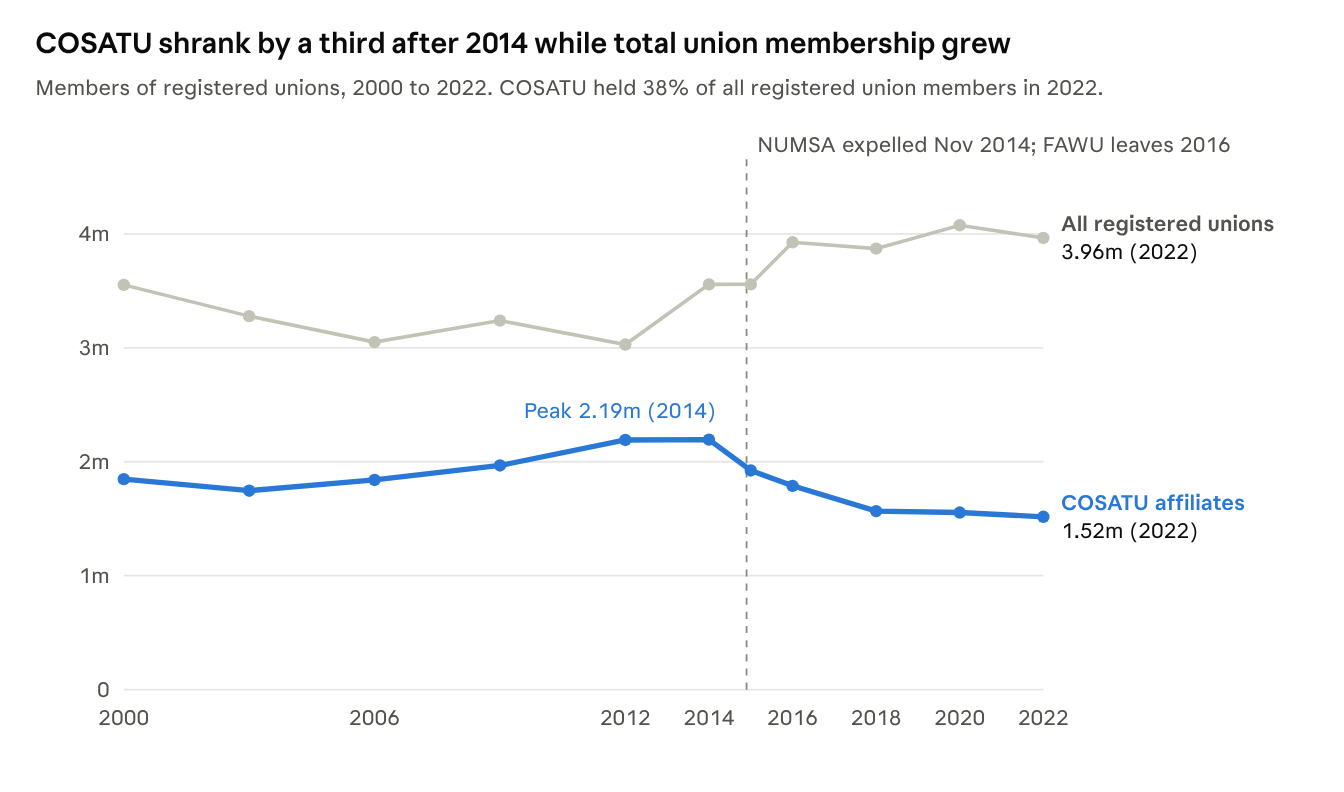
I would note four trends that define the landscape:
- Public versus private: Stats SA's Labour Force Survey shows about 66% of public-sector employees belonged to a union in Q3 2026, against 23% in private business. South Africa's public service is one of the most unionised workforces in the democratic world. Its private sector looks increasingly like the OECD average.
- COSATU has become a public servants' federation: Public-sector affiliates made up about 7% of COSATU's membership in 1991 and have been more than half since 2018. COSATU's organisational report puts its public-sector membership at 1.8 million; the federation entered its 2026 congress claiming about 1.5 million members against a target of 2 million. The two figures cannot both be right, which itself says something about the state of the records.
- The industrial base has shrunk under the unions' feet: Mining employed around 807,000 people at its 1987 peak and about 444,000 in 2025. Government and state-owned entities added roughly 600,000 jobs between 2008 and 2025, reaching about 2.75 million. The unions followed the jobs.
- The vulnerable are almost unorganised: Neva Makgetla of TIPS has shown that farm and informal employees made up a fifth of waged jobs but only 2% of union members. Retail, security, hospitality, call centres and the platform economy, where most new jobs are, remain thinly organised.
Fragmentation compounds the picture. There were 213 registered unions in November 2025, alongside COSATU, SAFTU, FEDUSA, NACTU and a range of independents such as AMCU and Solidarity. Researchers also warn that the data are weak: the Department of Employment and Labour no longer publishes annual membership figures, and at least one large COSATU affiliate reported an identical membership total for a decade. That last detail deserves emphasis.
A union that does not know how many members it has cannot know whether it is serving them. I often speak to employees who want to know what the R80 or other amount monthly membership fee buys them in the real world. Those answers are becoming more and more strained.
The factory floor today: who actually handles workplace conflict?
If unions were still the primary managers of workplace conflict, three things would show in the data: collective disputes would dominate, strikes would be union-led and spread across the economy, and dismissed workers would arrive at the CCMA with a union representative beside them. None of the three holds. Let’s investigate those criteria.
Conflict has been individualized
The CCMA received 193,069 referrals in 2024/25, of which 51% were unfair dismissal claims. The top referring sectors were private security and retail (13% each) and business services (11%): low-wage, high-turnover, thinly organised work. As far back as 2008, analysis in the South African Labour Bulletin found that about 70% of CCMA disputes were brought by individuals without union assistance. Nothing since suggests the share has fallen. Meanwhile, average turnaround times lengthened from 85 to 109 days as funding fell.
The state's dispute machine, built partly at labour's insistence, has become the de facto representative for millions of workers, and it is overloaded.
Strikes have become a public-sector phenomenon
In 2024 the Department of Employment and Labour recorded 114 strikes and R133 million in lost wages. The public sector accounted for 94.7% of working days lost; the private sector for just 5.3%, down from 23% the year before. This is not because private-sector workers are content. It is because, in much of the private sector, there is no organisation capable of mounting a protected strike.
When private workers do act, they often act without unions
The Casual Workers Advice Office's Strike Barometer found that more than half of all strikes in 2024 were unprotected wildcat actions, many over permanent jobs and outsourcing. A wildcat strike is the clearest possible signal of a representation vacuum: workers have a grievance, the collective energy to act, and no trusted structure to channel it. What fills the vacuum? In my experience, four actors:
- HR departments and line managers, who now run most grievance and disciplinary processes with no counterpart of equal skill across the table.
- Labour consultants and attorneys, who increasingly represent individual workers on contingency or for a fee, often at the CCMA's arbitration stage.
- The CCMA and bargaining councils, acting as conciliator of first resort for disputes that a competent steward could have settled in a corridor.
- Informal worker committees and advice offices, such as the CWAO, which have shown that unorganised workers will mobilise when someone shows them how.
Where unions are present in the private sector, the quality of representation varies enormously. Some stewards are formidable: sharp on the Code of Good Practice, disciplined in caucus, credible with members. If I was in the habit of making lists, I suppose my Top 20 formidable opponents in workplace conflict over the years would include a good many union officials. But too many are not. In disciplinary hearings I still see representatives who have not read the charge sheet, who argue politics when the issue is procedure, who cannot read a company's financial statements during a section 189 consultation, and who treat every dispute as a test of strength rather than a problem to be solved.
That is not a moral failing. It is a training and incentive failure, and it is the heart of the matter.
The global mirror: who adapted in this comparative study South Africa's decline is not unique, and that should be both a comfort and a warning. Across the OECD, union density halved from 30% in 1985 to about 15% in 2024. What distinguishes the movements that held ground from those that collapsed is not ideology. It is whether they kept delivering something members could feel. My work with European and South American unions often feel like unrelated work, with those unions proving to be robust, capable opponents, but also skilful stewards of their members’ interests, people who can work with you towards solid commercial outcomes.
| Country | Union density (latest) | Defining feature | Lesson for South Africa |
| South Africa | 66% public, 23% private (Q3 2026) | Alliance politics, statutory bargaining, public-sector base | Private density still high by world standards: an asset being squandered |
| Denmark, Sweden | Above 60% (2024) | Ghent system: unions administer unemployment insurance | Membership tracks tangible service; density fell as the Ghent link weakened |
| Germany | 49% bargaining coverage (2024) | Sectoral bargaining plus works councils | Institutions erode without organising: only 36% of private-sector employees have a works council |
| United Kingdom | 22.4% overall; 12.1% private (2025) | Decades of decline, now a modest rebound | Membership rose by 192,000 in 2025, driven by organising and bargaining fights |
| United States | 10.0% overall; 5.9% private (2025) | Hostile law, enterprise bargaining | Grassroots drives (Amazon, Starbucks, UAW) lifted union representation to a 16-year high |
| Australia | 13.1% (2024) | From 40% in 1992 to a floor | First rise in the membership rate since 2011 |
| Brazil | 8.4% of employed (2023) | State-guaranteed union tax abolished in 2017 | Unions dependent on guaranteed income collapse: revenue fell 97.5% from 2017 to 2021 |
| India (SEWA) | 3.2 million+ members | Union of informal, self-employed women | The informal economy can be organised, if the union offers services that fit |
Three lessons stand out for South Africa.
First, the public–private split is universal: In the United States, public-sector density is 32.9% against 5.9% in the private sector. In the UK the gap is 48.5% against 12.1%. South Africa's pattern is normal. What is abnormal is the political weight its public-sector unions carry, and the degree to which a public-sector-dominated federation still speaks as if it represents the industrial working class.
Second, Brazil is the cautionary tale: For more than seven decades, Brazilian unions lived on a compulsory one-day-wage levy collected by the state. When the 2017 reform made it voluntary, revenue all but vanished, and union density among the employed fell from 16.1% in 2012 to 8.4% in 2023. Unions that had stopped needing to win members discovered they no longer knew how. South African unions should look hard at their own dependencies: agency shops, automatic stop orders, facility arrangements and political access. None of these is guaranteed forever, and the GNU era has already shown that access to the state can shrink quickly: COSATU complained in 2026 that it had been left out of the business-government partnership on growth and jobs.
Third, renewal is possible, but only through craft: The modest recoveries in the UK, the US and Australia were not delivered by political alliances. They came from organizing campaigns aimed at young, service-sector and precarious workers, from unions willing to train organisers, run disciplined campaigns and win visible victories at specific workplaces. SEWA in India shows the same thing at the other end of the income scale: a union that organises street vendors and home-based workers by offering what they actually need, from credit and insurance to bargaining with municipalities. Workplace conflict has become a science with a few nods at art, and the outdated tools used by so many of our unions leave them seemingly unable to dig their way out of this hole.
Diagnosis: the atrophy of craft
Strip away the politics and a union is a professional service organization with a democratic mandate. Its craft has five components: organizing (finding, recruiting and activating workers), representation (grievances, discipline, dismissal), bargaining (preparing, negotiating and enforcing agreements), conflict resolution (settling disputes before they escalate) and member education. On each, the South African movement has regressed from where FOSATU stood forty years ago. The conflict theory lens makes the problem precise. Ury, Brett and Goldberg's classic framework distinguishes three ways of resolving disputes: by reconciling interests, by determining rights and by testing power.
A healthy system resolves most disputes through interests, uses rights as a backstop and power as a last resort. South African unions have become locked into the second and third modes. Disputes go to the CCMA (rights) or to the streets (power). The middle layer, where a skilled steward and a sensible manager settle the matter, has thinned out. That layer is precisely where unions once earned their members' loyalty. A total absence of knowledge and integration of the enormous potential of identity conflict in the workplace completes the sad stocktaking exercise. Why did the craft wither?
Six causes reinforce each other:
- Talent drain: For three decades the most capable organisers were promoted out of the workplace into Parliament, government, SOE boards and investment companies.
- Guaranteed income: Stop-order dues, agency shops and majority recognition reduced the need to re-earn membership. Brazil shows where that road ends.
- The public sector template: Centralised bargaining with the state in the PSCBC is political and macro-fiscal. It rewards mobilisation and lobbying, not plant-level negotiation. As the federation's centre of gravity moved to the public service, so did its skill set.
- An outdated organising model: COSATU's "one industry, one union" principle no longer fits a labour market of outsourcing, labour brokers, multi-skilled service work and platforms. The federation's own scholars now argue in New Agenda that its organisational strategy is no longer fit for purpose in either sector.
- Factional selection: When leadership elections are proxy contests between political blocs, office goes to the best caucuser (if there is such a word), not the best negotiator or organiser.
- Juridification: The LRA's sophisticated rights machinery rewarded legal technique over organising. Unions outsourced representation to lawyers and the CCMA, and stewards lost the habit of solving problems themselves.
To its credit, I think that the senior leadership generally knows this. Before the 2026 congress, outgoing general secretary Solly Phetoe told the CEC that the membership decline "cannot be treated as a statistical problem" and called on affiliates to return to the workplace and rebuild shop-floor organisation. The difficulty is that the congress which followed spent its energy on credentials, suspensions and electoral pacts. Diagnosis is not the problem. Priorities are.
The future: three roads and what renewal would demand
Over the next five to ten years, I see three plausible trajectories. They are not mutually exclusive, and different unions will take different roads.
Road one: the political vehicle
COSATU's October resolutions, its talk of a "socialist axis" and a Conference of the Left, and the SACP's electoral debut point toward a federation that increasingly behaves like the industrial wing of a left political bloc. This road offers visibility and leverage at moments of coalition bargaining. It also ties the federation's influence to a party that won around 2.4% of the vote, and it imports electoral factionalism into every affiliate.
Road two: managed decline
Public-sector unions remain strong but face a decade of fiscal pressure on the wage bill. Private-sector density keeps eroding as the economy shifts toward services, outsourcing and platform work. Dues-dependent structures hollow out. One day a legislative or court change to agency shops or stop orders produces a Brazilian shock. This is the default road. It requires no decision at all.
Road three: return to the craft
A deliberate, multi-year rebuilding of organizing and representation capacity, starting where the workers actually are. This is the hardest road and the only one that restores the movement's independent power. In concrete terms it would require:
- A firewall between union office and party office: Not a ban on politics, which is every union's right, but a rule that no one holds senior office in a union and a political party at the same time. Members should never have to wonder whose interests their leader is serving.
- Professional standards for representatives: An accredited, assessed shop-steward qualification covering the LRA, disciplinary procedure, section 189 consultation, basic financial analysis and mediation. Upgraded, not from the 80s playbook. Stewards should be as credentialed as the senior HR practitioners across the table.
- Audited membership and published service metrics: Verified membership numbers, case outcomes, turnaround times on member grievances. A union that measures its service can improve it.
- Organising where the jobs are: Security, retail, hospitality, call centres, agriculture, platform work and the informal economy. The CWAO and SEWA models show that unorganised and precarious workers respond when organisations bring practical help rather than speeches.
- Interest-based competence: Revive section 80 workplace forums and joint problem-solving structures. Train stewards in negotiation and mediation, not only in mobilisation. The best unions abroad win more in the corridor than on the picket line.
- Re-earning the subscription: Legal advice, financial counselling, skills and credentials, digital access to a real person within 24 hours. Every rand of dues should buy something a member can name.
- Public sector unions owning service delivery: The unions of teachers, nurses and municipal workers are strong enough to lead on productivity, accountability and service quality. If they do, they will win the public argument about the wage bill. If they do not, they will lose it. The damage is very visible at the moment.
Employers have a stake in this too. An employer who celebrates a weak union is celebrating the absence of a conflict manager. Weak representation does not remove conflict. It drives it underground into absenteeism, sabotage, wildcat stoppages and a queue at the CCMA. Joint investment in steward training is cheaper than any of those.
Closing: respect, and a serious question from a friend
South Africa's unions earned their place in history the hard way, in hostels and on factory floors, under bannings and detentions, long before they had offices in Braamfontein or seats at NEDLAC. Nothing in this article diminishes that. But history is not a mandate. Every generation of members is entitled to ask what its union does for it now. The honest answer, for too many workers, is: less than it should. Not because unions have become villains, but because they have become something other than what they were built to be.
They have become political institutions that also do some representation, rather than representative institutions that also do some politics. The movement does not need a new ideology, a new federation or a new alliance partner. It needs to rediscover a trade: the patient, skilled work of organising people and resolving their conflicts well. Those that do will find that political influence follows. Those that do not will learn, as Brazil's unions did, that influence borrowed from the state can be recalled at short notice. The goodwill that made trade unions near-superstars in the 80s and 90s, workplace heroes, has not disappeared completely. But it can.
RESOURCE LIST AND SUGGESTED READING
- Martin Nicol, "COSATU membership and registered unions, 1980–2025", New Agenda 100 (March 2026)
- New Agenda, Special focus: COSATU at 40 (2026)
- AllAfrica, "Why trade unions have shifted to the public sector" (November 2026), citing Stats SA QLFS Q3 2026
- Business Day, "Cosatu heads into congress with political fault lines exposed" (1 September 2026)
- TimesLIVE, "Cosatu faces unity test amid rising worker challenges" (24 September 2026); "Cosatu puts the ANC on notice" (15 September 2026)
- EWN, "COSATU elects Mike Shingange" (14 October 2026); Business Day, "Cosatu to back both ANC and SACP" (14 October 2026)
- Daily Maverick, "SACP's strong showing signals end of the Tripartite Alliance" (9 November 2026)
- Business Day, "Unfair dismissals make up more than half of CCMA cases" (23 September 2026)
- Department of Employment and Labour, Deputy Minister's budget vote speech (July 2025)
- IOL, "Workers lost R133 million in wages due to strikes in 2024", reporting the DEL Industrial Action Report 2024
- AllAfrica, CWAO Strike Barometer coverage (February 2025)
- South African Labour Bulletin, "Top five CCMA users: can they do better?" (2008)
- Neva Makgetla, "Boots and helmets make way for aprons and caps", TIPS / Business Day (2023)
- OECD, Membership of unions and employers' organisations, and bargaining coverage (2025)
- Anders Kjellberg, Union density in the Nordic countries (2025)
- Destatis, Employee representative bodies (IAB panel 2023); Eurofound, Collective bargaining coverage rates (2026)
- UK Department for Business and Trade, Trade union membership 1995–2025; TUC, private and public density
- US Bureau of Labor Statistics, Union membership rate 10.0% in 2025; EPI, Union membership rose in 2025
- Australian Bureau of Statistics, Trade union membership, August 2024
- IBGE, Union members fall to 8.4 million in 2023; The Brazilian Report, union revenue after the 2017 reform
- D+C, "A union for informal workers – how does that work?" (SEWA)
SOME OF MY OWN PUBLISHED WORK
1. I have written extensively on union development and participation in the workplace, and their role in effective workplace conflict. MY book Dangerous Magic: essays on conflict resolution in South Africa and articles such as can be found at The Conflict Conversations are publicly available examples.
2. Our blog at www.conflict-conversations.co.za contains a rich selection of articles over the last few years, dealing with workplace conflict, the interlocking building blocks of identity conflict and related subjects.
- Full references, further reading material, courses, coaching, study material, workshops / seminars, mediation and representation are available on request.
- A summary of Andre Vlok’s CV / bio can be accessed at https://www.conflict-conversations.co.za/conversations/2025-online-curriculum-vitae-andre-vlok
Andre Vlok can be contacted at andre@conflict1.co.za for any further information.
(c) Andre Vlok
November 2026