UNFINISHED EMPIRE: TAIWAN AND THE REUNIFICATION IMPERATIVE - The China / Taiwan conflict, the inevitability of war, the options, timing, and its impact on South Africa
War is a grave affair of state; it is a place of life and death, a road to survival and extinction, a matter to be pondered carefully.
Sun Tzu, The Art of War, Ch. 1 – Minford translation
When two great forces oppose each other, the victory will go to the one that knows how to yield.
Laozi, from the Tao Te Ching
Introduction
The Economist cover of the 1st May 2021 dramatically depicted Taiwan on a radar screen, adding the statement that this was “the most dangerous place on earth” This classic media technique to focus attention on a specific question was rather hyperbolic, but in the five years since then the question as to the future of Taiwan remains unanswered, as it has been for the last eight decades. Much has happened in those five years, with several further puzzle pieces having been added. What do we see when we assemble these in the correct sequence?
A note on the use of terminology
The complex topic of the so-called China/Taiwan conflict normally runs into conceptual and terminological difficulties right from the outset, especially in popular analysis and media discussions. This then often descends into more heat than light, in a topic that is already contentious and fraught with very precise ideas and concepts. We will briefly deal with the history of the regions that led us to here, but for now it is, even at its most basic level, necessary to be aware of the existence of the People’s Republic of China (PRC, the “China” in conventional discussions) and the Republic of China (ROC, the “Taiwan” in conventional discussions).
Imprecise use can cause offence, or lead the debate astray, and given the complexities that lie ahead, we need no additional distractions. People native to Taiwan refer to themselves, generally, as Taiwanese, while people in mainland China may make use of the politically preferred term “Taiwanese compatriots”. In this article we will, as it is written for a mainly English language audience, use “China” or “the PRC” as referring to mainland China, and “Taiwan” or “the ROC” as depicting what conventional Western discourse refers to as Taiwan. The importance of accuracy can be illustrated by a fact necessary for a full understanding of our discussion here, and that is that for the ROC independence, and its claims to its sovereignty, are not the same thing. This will become clearer as we unravel the nuances of the various positions. In the process of our assessment and conclusion, I have to at times simplify otherwise complex situations, intricate and interrelated webs of fact and fiction that would receive more specific attention in fieldwork.
There are, as it is, already significant differences in how Western conflict management models view and approach conflict, and how conflict is viewed and approached in China (see the link to my four-part series below), so we need to be as accurate as possible where this is possible.
Our strictly conflict management focus
The history of this particular area of the world, focusing on say the 1920s to the present moment is a truly fascinating one, deserving of far more attention than what it so often receives in the Western focus. It is a complex, disputed tale, with several strands woven together into the present situation. Our histories, and how we experience them, are of course essential aspects of our identities, our values, and they play a crucial role in some of our conflicts.
In that regard, the histories leading up to here are of great importance, and later on in the article we will see in what specific way this should be respected and included in any meaningful understanding of the conflict options open to the involved parties. But it is also inevitable that too much focus on this history will slow us down, will broaden the scope of disputes, not all of them fruitful to an assessment of the journey out of this seemingly intractable, endless cycle of conflict. What the article will do, is to approach our analysis strictly on the questions and facts relevant to treating this as a high-end conflict management mandate. What are the factors creating and maintaining the conflict, what forms can it take, and what are the options and avenues towards resolution open to the parties.
In doing so, we will take a real-world look at the conflict, and avoid comforting platitudes. One of my initial assumptions in approaching this crucial conflict puzzle is that the suspended tensions, conservatively frozen for these last 75 years, will not hold indefinitely, and that something will give, in the conditions and frameworks that we will discuss. We will then, as tempting as it may be, refrain from strolling down historical byways and cultural arguments. We are dealing with this as a potentially urgent conflict management exercise, and we are dealing with the situation as it is, with the cards lying where they are, not as we or others want them to be.
For our primary focus we are not looking at how or why things got the way they are, we are simply considering the options, and the best way to take the conflict further. In doing so, I believe that all three the main conflict strategies – management, resolution or even transformation – are still available.
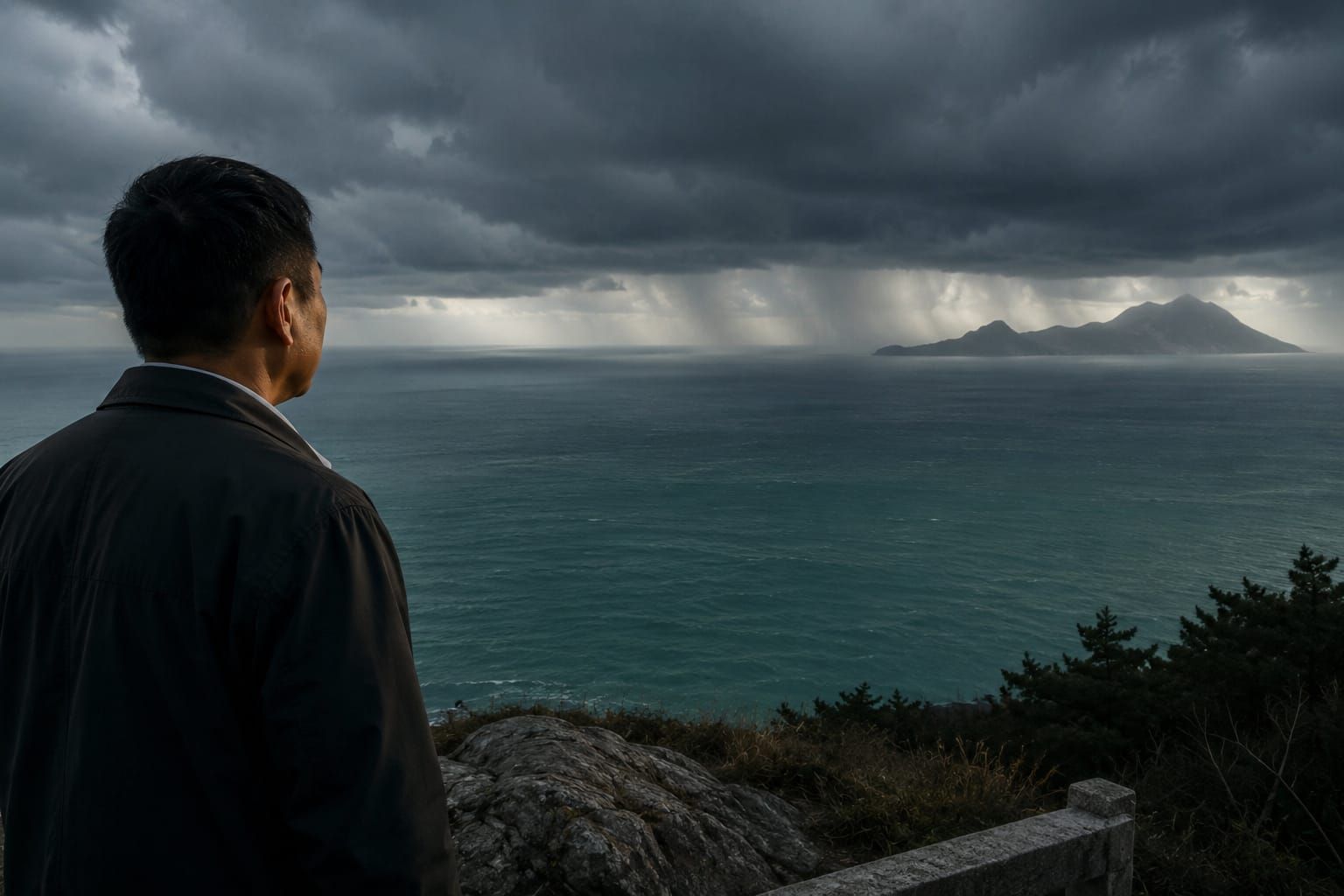
A brief historical introduction
The interested reader can while away many a fascinating hour in reading about the history of this conflict, and the suggested reading list at the end of this article presents a few choice examples of such material. For our purposes here, we can simply accept the reasonably common cause facts that the main dispute started during and after the Chinese civil war of 1945-1949, where, in very simplified terms, communism clashed with nationalist authoritarianism, the split into the aforementioned People’s Republic of China (PRC) and the Republic of China (ROC), with the latter declaring Taipei on the erstwhile island of Formosa as its capital on the 7th December 1949. This, in a not-too-trivial sense, makes the China / Taiwan conflict an unresolved civil war.
The alert reader would have noticed the immediate clash in terminology. This is not a conflict akin to the breakaway republics of the southern Africa of a century and a half ago, this is not the secessionist conflicts of earlier or present days – both these groups regard themselves as the sole, legitimate manifestation of China, two entities claiming to be the historical nation of China. This historical background is not just mere semantics. Breaking away from the original country is one thing, being the original country another. We will also see the tremendous effect this has on the all-important identity conflicts at play in any possible resolution of the matter.
Legal claims
Historically then, the various claims fall open on relatively common cause lines. Legally, the various claims have no guiding precedent, also for a number of simple reasons. Taiwan is of course not a member of the United Nations, which excludes the International Court of Justice. China, as a permanent Security Council member, would in any event probably block any jurisdictional requirements.
There are occasional scholarly debate and scenario development around hypothetical ICJ cases, and domestic and foreign courts (Japan and the US, for instance) have pragmatically dealt with Taiwan’s status, often in dealing with other peripheral matters such as commercial or jurisdictional disputes. This absence of legal guidance or the ability to authoritatively determine any of the issues involved leaves the conflict as one to be engaged with in the political sphere.
Global views
Should global views of the status of Taiwan play a role in our assessment and strategy generation? It can be argued that there is some persuasive value to that type of argument. For what it is worth at present, we notice that Taiwan currently has only 12 entities recognizing the ROC as a sovereign government (11 UN member states and the Holy See / Vatican City). Even this metric has been on the decline, with Taiwan losing about ten of these allies in the last decade.
Other countries (more than 180 UN members) recognize the PRC as the sole legal government of China. The distinction may not always be as clear-cut as all that would indicate, with Taiwan maintaining unofficial ties of various types (commercial, security etc.) with the US, Japan and Australia, as examples. Various recent polls (2024/2025) across Western democratic countries indicate a generally positive view of Taiwan, but the framing of some of those polls are often so vague as to make their results rather meaningless for our purposes. In this rather vague popularity exercise it is also sometimes difficult to determine which is the result of China’s “One China” policy, and which is an independent assessment by the countries involved.
Ultimately, polls do not help us with a practical conflict strategy here.
Possible resolution categories
What are the theoretical possibilities of resolution of this potentially wicked conflict (“wicked” in the technical sense, of being a complex, interconnected conflict that is difficult, or impossible, to resolve definitively due to its incomplete, contradictory or ever-changing nature)? Let us briefly sketch what may be regarded as possible resolution categories, without too much detail, and then we assess the probability and advisability of each.
Firstly, the option so much on everyone’s mind: a military solution. Here China attacks Taiwan militarily, is victorious and reintegration is established through the barrel of a gun.
Secondly, a negotiated, and probably mediated, settlement is reached, whereby the parties come to an agreement that prevents the first option.
Thirdly, the status quo is simply maintained indefinitely, everyone talks about it and no-one wants to really do the work necessary to resolve it, people come and go and nothing happens. If you think that is an absurd possibility, remember that that is pretty much how things have been since 1949. Prof Brandon Yoder has argued that there are not that many benefits to retaking Taiwan for China, not military or economic benefits, at the least, which of course changes the urgency and the existence of the debate somewhat. Ultimately, and mostly because of our difference in reading the identity conflict implications as opposed to purely rational and commercial considerations, I do not agree with his conclusion. China will have to bring about reunification, the questions are simply how and when.
Fourthly, and only as a placeholder and concession to the improbable speculation that some other confluence of events (a larger world war, internal political strife or collapse in either country etc.) could open other future conflict outcomes, we can keep a “general / other” category open. Let us then briefly assess the value and cost / benefit analysis of each of these categories, within the limited space available to us, with each of these options of course requiring tremendous depth and detail as final strategies.
i. The feasibility of a military invasion
Sooner or later, most formal or informal discussions about this conflict touches on the seemingly inevitable, to some, resolution of the situation by way of military means. But how feasible an option is this? What would be attractive for China in such a military invasion? The list is a long and very compelling one, in my view. Arguably the strongest point in such a decision would be the strategic and national value of reintegration of one China, the removal of this source of incompleteness, this part of the “century of humiliation” in China’s national narrative. Mission accomplished. The value of this to Xi Jinping’s geopolitical and national stature would be incalculable, and his legacy will be cast in stone. The man who reunited China, who brought the One China policy home.
It is also difficult to value the securing of Taiwan’s advanced semiconductor industry, with TSMC producing 65% of global semiconductors and 90% of the most advanced of such technology. Such a victory would of course, at least in China itself, be seen as a victory over a democracy, a not too small propaganda win. Control of Taiwan would break the “first island chain” strategic benefit in the Pacific, and could potentially constrain US naval access in the area. Taiwanese soldiers, at least those potentially involved in such a defence, have very limited fighting experience at this stage, and surprise or deception attacks may overwhelm them, along with a strategy of system destruction early on.
The Trump administration recently seems to have all but given the assurance that it will stay out of any such a military development, removing one of the very powerful deterrent factors in the calculations until now. Also, a victory, especially a quick one, would be a wonderful local boon to patriotism and nationalistic emotions in China, justice would be seen to be served, and so on.
Given the compelling arguments in favour of such a military victory, what would militate against such an attack? Amphibious assaults across the Taiwan Strait will, by all assessments, be a tremendously risky venture. Much like we saw recently in the Iran war, geography remains a high value determinant of military success, and the 130 to 160+ km of the strait could prove to be very risky. Taiwan’s geography (the mountainous east, very limited access to beaches etc.) would certainly favour defenders. China itself has very little if any experience in naval landings, while Taiwan’s insular realities would have prepared it well for a defensive role, using its geographical assets.
Wargame simulations, such as the 2023 CSIS results, show heavy and sustained Chinese losses of air and naval assets and heavy casualties, and that even without full-scale US intervention or assistance. Military intervention by the US, or Japan, or a coalition of forces, could very easily escalate into a full-blown regional or wider war, and of course at that stage, the nuclear options come into play. And then things can get worse. Global semiconductor disruption could cost trillions, trade and other sanctions or isolation could irreparably damage China’s export-dependent economy, blockade options may not be effective in the short-term, and the political backlash of a loss, or even an unconvincing, costly victory could severely harm the CCP. The military analysis on its own tends to give a picture of high risk low probability of meaningful military success.
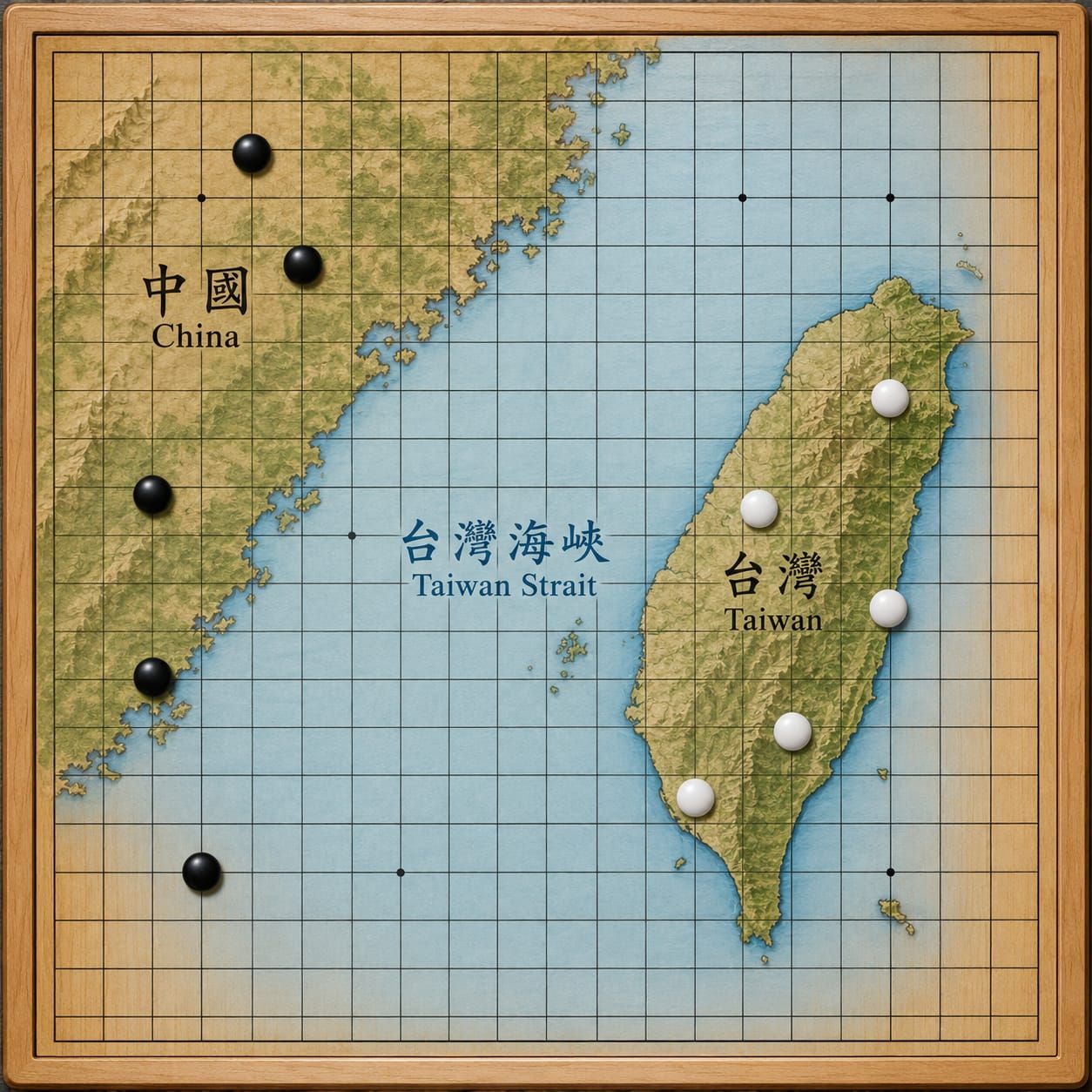
Any such military attack, other than a rather dubious blockade strategy, would need to face these realities grimly, and nevertheless try to push through. Military victory for China can certainly not be excluded, despite these obstacles. As Cyrille Javary points out, the Taiwan Strait is not a chess board, but a wéi qí board, with its dynamics and timeframes, and the understanding and reactions thereto, that requires a sound understanding of the minds at work in this conflict over and above mere columns of men and machines.
ii. A negotiated, mediated settlement
Is such a military conclusion, one way or the other, inevitable though? Not at all. The possibility of a negotiated, probably mediated, settlement must be assessed, and remains a strong option. This is what my mediator’s training and a library full of mediation and conflict negotiation textbooks and best practices tell me, as well as the recent signposts in that direction, especially during the last five or six years support, as we will assess further on.
The parties can, and on this view should, negotiate a way through the current impasse. The stakes are high, existentially high. Taiwan, facing seemingly overwhelming odds, public sentiment and that inevitable pull towards resolution may be convinced to resolve the sword hanging over their heads by way of a settlement of sorts.
We will assess this option in the section below, but what would such a potential settlement look like? What could the parties offer each other that would tip the calculus towards an agreement? Such an answer requires some creative thought. Nothing compelling presents itself at first.
Peace, resolution, getting on with life, a new and unified future, comrades together – sure, that would get the discussions started. But what of substance could be achieved that is more compelling than the risks inherent in a military option? What could force resolution when there is no real mutually hurting stalemate, as required in conflict studies, when one of the perfectly acceptable answers is “We do not need to decide right away”. At this stage, there is no crisis, and the calculations have an academic tone to them.
But let’s say that such a crisis, such a MHS is created somehow, by design or by circumstance. A creative and collaborative approach could see some detail for agreement emerging. To continue to see China as the dark, destructive world of Communism is to have missed developments of the last decade. It is simplistic and misleading to see the negotiation options as being constrained by crude market and governance clichés. There are very clear free market and capitalist models and exceptions visible in the Chinese economy, and the semiconductor industry is of such enormous military and economic value to China that it could be a strong lever towards creative solutions.
But Taiwan could of course not push such concessions too far, even if they wanted to. The basic Chinese political structure, the rules and ways of life of the PRC, will have to prevail as is, and Taiwan could never negotiate its continuation as some form of democratic enclave within the greater China. Any such model, if that threshold is reached, will have to be built around existing and acceptable Chinese models of governance and economic models. I would suggest that such models exist already.
Another possible avenue would be to concede reintegration by agreement, but after a specific period. Learn from the Hong Kong options and mistakes (as out of favour as that specific implementation is in the higher CCP circles). Prevent the loss of life and property caused by a forceful reintegration by agreeing to a staggered, managed reintegration, giving people ample time to adapt, compromise or leave. I will expand on these options below, in the assessment section.
iii. Maintaining the status quo
Recording this as a conflict option feels a bit like a cop-out, an evasion of our assumed responsibility of resolving this conflict. But as I have mentioned earlier, objections to this are more apparent than real. The ROC could hardly have drawn the line in the sand clearer than say December of 1949, and here we are – no military evasion, no negotiated settlement. No war, no peace. This seemingly evasive option has the value of 75 years of de facto weight and inertia behind it. “We will deal with it, just not today” is a popular and powerful human conflict strategy. The past proves to be the safe option – careers cannot be ruined if no mistakes are made.
iv. Other possibilities
Are there other possibilities that may come into play? Given the very clear move to geopolitical realism I would certainly not discount such possibilities. A larger canvas war may turn the China / Taiwan conflict into little more than a regional skirmish, future realignments of power in the multipolar world may bring about new options and possibilities (some of them rather grim), and internal political developments in either China or Taiwan may make some of the current conflict outcomes more or less probable. Internal future political strife and instability in either of these countries may see the needle move on the probabilities of some of the current options. These admitted possibilities of course play well into the third option: wait and see how things turn out.
An assessment of these conflict options
Those then are the main possible resolution categories. But are any of them realistic options, and how can we rank them? Option (iv) above is a bit vague for purposes of evaluation, and (iii) is just maintaining the status quo, with the occasional escalating or de-escalating, planned or unplanned, conflict event taking place. War, or peace by way of a negotiated settlement, then. Option (i), a military solution, has its strategic downside, as we have seen. It is of course often seen as the simplest option, the option where a lot of leaders feel most at home.
War, when it does its job, unifies and focuses a nation on an external enemy, and all the identity conflict benefits that flow from that can be channelled by wise and knowledgeable leadership. As a military option, we have seen the risks and arguments against such an option. How probable is this in any event? The last time that China started, and was involved in a war, was the 1979 Sino-Vietnamese war, a brief conflict at that, so China can hardly be accused of warmongering or an appetite for war.
The recent war exercises (the so-called Justice Mission of December 29-31, 2025) may argue that this is about to change, but we also need to remember that these military exercises are routine events, rather clearly designed to discourage attempts at independence. Justice Mission was certainly the largest and most extensive drill to date, at least as far as geographic scope and open aggression was concerned, but again, we should be cautious to see this as necessarily being evidence of China preparing for war against Taiwan.
The exercise was very clearly marked as a “stern warning” against Taiwan’s “separatism” and the “external interference” of the US’s $14 billion arms sales package. For reasons that can easily be guessed, this planned arms sale has also now been paused, ostensibly in order to prioritize the replenishment of US munitions stocks.
Su Chi, who was centrally involved in the 1992 Consensus, referred to US support for Taiwan that has always been “the log that sustains the fire of Taiwanese independence”, and that China, as he sees these developments, have now removed that log. Still hurting from the Iranian fiasco, and with its own military capability being both depleted and under intense scrutiny, the US would be hard-pressed to generate a convincing rationale for effectively participating in such a conflict.
These developments make war less probable in my view, not more, as is the popular narrative. All of these military exercises also very clearly practice blockade and quarantine scenarios (including Strait Thunder of April 2025, Joint Sword of 2024).
While their frequency and scale have increased, this may be attributed to factors such as the offence caused by Nancy Pelosi’s rather ill-advised visit to Taiwan in August of 2022. As can be expected, China defends these exercises as being necessary due to Taiwan’s provocations and external threats, while Taiwan frames them as intimidation and aggressive signalling of intent. For now, let’s bookmark a military option as a feasible result, and return to it in our concluding section below.
While we are dealing with military outcomes, what role and importance, if any, should we assign the Japanese position on this conflict? With Taiwan being situated just 130 km from Japan’s southernmost islands, any overt military conflict against Taiwan is certain to raise deep and immediate concerns and reaction from Japan. It is difficult to see Japan simply sitting out a direct military conflagration. In November 2025 the Japanese Prime Minister, Sanae Takaichi stated rather bluntly, in parliament, that any Chinese use of force (including a blockade) against Taiwan would induce a “survival threatening situation” for Japan. This statement was significant enough to have triggered a major and acrimonious diplomatic crisis between China and Japan.
While Japan still maintains its adherence to the 1992 One China understanding, it has also begun the sharp increase of its military spending and, to my assessment, a much more outspoken attitude to what it views as China’s assertiveness. US intervention, if that should occur, would of course also then involve their forces situated at Okinawa and so on, again heavily involving Japan in any such military activity. In military assessments then, Japan should be seen as playing a potentially significant role in the weighing and designing of options, especially I would think in areas such as what has become known as “integrated deterrence”, alliance coordination, and gray-zone management.
As far as a negotiated settlement is concerned, we looked at the conflict dynamics of this instinctively preferable option above. As much as I have indicated some potential grounds for such a settlement, I will also concede the apparent unlikely occurrence of such a result. Purely as a negotiating exercise it is already severely limited in creative options, and then we get to the essence of the obstacles in that category, that of the dynamics of identity conflicts. This conflict is not just a geographical or economic dispute, where concessions can be traded. There is precious little, if any, meaningful middle-ground. The terms of the conflict are existential, and classic identity conflict territory.
Rational assessment, option-generation or conduct becomes limited, deep-seated emotions and experiences play tremendous roles in shaping opinion and options, the mere fact of conversing with the other may be seen as disloyal, and radical options become more acceptable, as long as it suits the in-group narratives. Xi Jinping has been very good in the public management of those narratives, but the mechanics of identity conflicts remain intact.
A factor that will complicate persuasion efforts in any negotiation processes is the fact that a very distinct Taiwanese identity has been created by now, especially among younger Taiwanese, built around in-group narratives of a democratic society, a free economy and trade, and, to a lesser extent, a Western lifestyle. Negotiations would need to be carefully shaped around the very specific strategies of uniting distinctly separate identity (and value) groups. Both these involved societies are remarkably strong honour-based societies, and any settlement perceived subjectively as dishonourable, insulting or shameful will be rejected, regardless of any other rational arguments commending such an agreement.
The government on the receiving end of such a proposal will struggle inordinately to convince their constituents of the wisdom of such a proposal, and it can easily bring about the fall of such a leadership. Failing to meaningfully persuade the relevant country of such an agreement, or part thereof, may very well lead to sufficient rejection thereof, and possibly leading to rebellion, public uprising or protests, all of which can lead back to a military conclusion.
As case studies and experience show, in identity conflicts as complex as this, the very process itself would have to be subjectively perceived as fair and reasonable, failing which again, we may see the rejection of otherwise sound proposals. Any such an agreement would have to be built around not just sound rational principles, but also effective face-saving principles. A golden bridge, an off-ramp, of rather unique proportions, will have to be constructed. Would any of the frameworks that I have suggested prove strong enough to transcend these identity conflict dynamics? William Zartman used to say that “you do not negotiate identities”, and in this classic conflict case study we have a real-world application of that principle.
A study of existing efforts by the parties at a negotiated settlement of the conflict brings a measure of hope. During the early 1990s, Taiwan discarded its “three no’s” approach (no contact, no negotiation, no compromise), and semi-official discussions via the Straits Exchange Foundation began. This led to the so-called 1992 Consensus, an apparently vague understanding that “there is one China”, without much further consensus. The value of this event lies more in being that first renewed step, a glimpse of what may be possible.
In 1993 the Wang-Koo Summit in Singapore started to deliver more practical results (involving document verification), and in the period 2008 to 2016 we saw no less than 23 agreements being achieved during 11 high-level negotiations. Concrete steps towards progress included direct flights and shipping, improved trade and investment through the ECFA Cross-Strait Economic Cooperation Framework Agreement, tourism, financial services, crime fighting, and a historically important meeting between Ma Ying-Jeou and Xi Jinping in Singapore during 2015.
This slow momentum was suspended post-2016 as a result of the Democratic Progressive Party assuming power in Taiwan in 2016, first under Tsai Ing-wen, and then under Lai Ching-te. I say “suspended”, as I would argue that it is certainly not necessarily a termination of the work done this far. China demands a return to the framework of the 1992 Consensus, while the DPP regards those demands as a precursor for reunification, and China regarding the DPP as “separatists”. The DPP has, predictably, called for talks to commence without any such pre-conditions. Some contact continues at lower levels, through channels such as cultural contact, business relationships and so on).
The progress made in the abovementioned areas is real, but it is noticeable that the essence of the negotiating puzzle, that of sovereignty, has hardly been touched. Whether these negotiations should then be seen as a small glimmer of hope, or a practical display of how intractable the conflict is, is of course its own debate. I lean in the direction of the former possibility.
Timing of any military invasion
Time, and timing, is a valuable indicator and determinant in most conflicts. Assuming a relatively endless timeline, and a complete absence of urgency or a mutually hurting stalemate continuing, resolution never seems absolutely necessary, certainly never as a pressing result that warrants the immense risk, cost and work inherent on any option other than maintain the conflict inertia that, in its own way, worked so well until now. If the conflict dynamics are going to be escalated, it will have to be done so by design. It is most improbable that this will willingly happen from Taiwan’s side. A military option, given the strategic realities we discussed earlier, would need an element of surprise and overwhelming force from China.
In this option category, when would the best strategic time be for such an attack? For obvious reasons, such a question is receiving quite a bit of popular media attention. The stakes are high, not just for China and Taiwan, and it is a fair question to consider.
A full scale Chinese military attack, whether an amphibious invasion or a major blockade, would need to be planned around many strategic factors and elements. Late 2026 to mid-2027 makes some sense in internal Chinese events, for example the PLA’s centennial. Xi may be seeking a massive political victory like this prior to the 21st Party Congress, slated for 2027, especially amidst domestic challenges. The current US election dynamics may also play into such a conclusion. I am aware of the US intelligence assessment noting that there are no fixed invasion plans for 2027, but this would be the earliest window, and for those reasons. China has, after years of military build-up certainly reached a threshold where such an invasion has become materially possible.
Weather-wise, regardless of the year of such an invasion, the Taiwan Strait’s weather realities would limit viable windows for attack to April and May, or September to October of any given year. Internal Taiwanese events, such as political developments, may add to the arguments for or against a particular time period, with instability or other distractions being valuable aids in any such an attack. If we accept that the present, or then early 2027, is a timeframe where China has reached a capability threshold, does waiting longer than that for an invasion add or detract to waiting from the Chinese perspective?
President Trump’s May 2026 visit to China, and subsequent messaging, has made it clear enough that the US has no predictable intention of meaningfully getting involved in the conflict. Trump, in an interview at the end of the visit, indicated that he would not want a party to say “Let’s go independent because the US is backing us”.
From this, it is reasonable to conclude that (a) China will be materially ready to launch such an attack late 2026 – early 2027, but that (b) Taiwan’s position is unlikely to improve as time goes by, further removing any real urgency caused by a deteriorating timescale.
Some of the renewed interest in popular and social media in a 2026-2027 timeframe stems from the sharp global swing to geopolitical realism on display and the Trump administration’s contributions to global uncertainty, while some of it can also be attributed to a misreading of earlier events. In March of 2021 the then commander of the US Indo-Pacific Command, Philip Davidson, warned in testimony before the US Senate Armed Services Committee that the PRC was adopting an aggressive posture towards Taiwan, and that a PRC attack on Taiwan is “imminent” and he then added speculation that this may occur within six years. At the same time, the Biden administration had concluded that China had become “impatient and more prepared to test the limits and flirt with the idea of reunification.” These are no longer convincing arguments for such a major military attack in the next 18 months.
Implications for South Africa
Any China / Taiwan conflict clearly has enormous implications globally, from the superconductor implications, to a regional war spilling out into a wider, even world war, with potential nuclear aspects, and its predictable effects on global trade and economic catastrophes of a bewildering range.
What would such an escalated war mean, in practical terms, for South Africa’s interests? South Africa of course recognizes the PRC under the One China policy, and has very limited relations with Taiwan. With China being South Africa’s largest single trading partner, a war could potentially trigger Western sanctions against China, which may have a range of economic knock-on effects on the South African economy through, for example, mineral exports, lower commodity prices, supply chain disruptions and so on. The potential global semiconductor shock could affect South Africa directly and indirectly through higher costs and shortages in the automotive manufacturing and IT industries, green tech such as solar panels and EV batteries could be disrupted, freight costs could be negatively affected and so on.
A long, drawn-out war, especially one that becomes deadlocked, could negatively affect Chinese investments in South Africa, at the very least making it more uncertain and unstable. Taiwanese investments could be lost or scaled back, which would have its inevitable results on employment here. The BRICS dynamics in such a war should not be underestimated. South Africa’s already strong relationship with China would need to be echoed in the BRICS relationship, which could attract strained relationships with other countries more critical of China or such a conflict itself. Employment, inflation, cost of living, energy demands and capabilities, all add up to significant potential collateral damage for South Africa in such a conflict. The scale, duration and, to an extent, global reaction to such a war would further add to the extent of such outcomes.
Evaluation and conclusion
We live in the days of the new Realism, the blatant return to the politics of power, and with new levels of application of lessons learned in past attempts at this strong-man approach to national interests. The sole superpower idea, or then a more realistic bilateral division of the world, has gone, and the new world is trying to find its feet in a new multipolar framework, and this upends the use, and meaning, of power. New alliances, new opportunities, new risks and conflict outcomes are barrelling down the highway of the brave new world.
This turn of world events may be adding one additional reason to the intriguing question of why China would now, after all of these years, seek to make an actual attempt at reunification. Launching such an effort, in any of its potential forms, would look a lot different, and would probably be received differently, in a world that has become accustomed to very serious claims against the sovereignty of Greenland, Canada, and where a country like Venezuela can be invaded and subjugated before breakfast. And what do we see following on such events, events that not that long ago would have triggered global condemnation and action such as economic and trade sanctions, and even stronger options? We see memes and the shaking of heads, and not much more. From a cynical perspective, the time for previously unacceptable land invasions have never been better than the present.
I would also argue that the slow twilight of the US empire has brought it to the realization that it is no longer really the world’s policeman, and that is no longer even competing with China in some respects. The “China as enemy” narrative, at least in the Trump administration, is really just for internal consumption. The US position on the conflict has changed over time, even taking a shorter timeline, say from Nixon’s 1972 acceptance of the One China policy under the PRC. For Taiwan to rely on the US as an ally in this conflict would be a position misaligned with the facts on display this last year and a half. The political environment has never been riper for reunification than anywhere in the last 75 years.
We have seen that morally and legally no truly convincing case can be made to halt any such Chinese ambitions. Any significant military or other aid from other countries, the US in particular, has diminished from the days where it was regarded as a given, as a meaningful deterrent factor. Until such time as this changes in any important aspect, outside assistance must be seen as speculative and of minimal deterrent value.
The strongest arguments against such an invasion or focused attack of whatever nature, would then appear to be military and strategic considerations, and a bleak landscape of potential negotiation options. What should we then expect from this complex conflict? What would we do, as a thought experiment, to resolve matters?
From Taiwan’s perspective there is no urgent call to action that justifies the opening of Pandora’s box, other than the possibly misplaced confidence that a pre-emptive and pro-active approach would lead to a successful resolution. From public statements from Taiwanese leaders and activists over the years, this is of course not beyond the pale, and it is perfectly understandable impulse to have. It is one thing to say that nothing much has happened in the last 75 years, it is another to live with that uncertainty, and to build a future in a country that may change drastically. My simplified advice to Taiwan would be to indeed play the long game, to try to revive the earlier negotiation processes if it becomes an urgent reality, and make your progress there.
From the Chinese perspective, things are of course more complicated. It is my sense that the Chinese leadership has become unwittingly trapped in the triangle of conflict options, where a military versus negotiated settlement are weighed, the risks clearly understood, and then the pull of that comfortable, safe option of “later”, of resting on the status quo, comes into play.
It is, in my view, naïve to believe that this decades-long leaning against each other will endure indefinitely. I say this not because of war games or political statements, or even the very popular “They will attack because Trump is in power” argument, but because of my assessment of the identity conflict dynamics so clearly at play. The stakes are so high, and they are driven into the ground so deeply, that somewhere this tension will have to give, and that triggers a few very limited options, as we have seen.
Identity conflicts have their short-term benefits: in mobilizing the in-group, in establishing convincing narratives, in driving great national projects in a coherent manner. But they also dictate that at some stage, patience and a long game run the risk of being seen as weakness, as an inability, as poor leadership. This is of course something that an honour-based leadership cannot consider. Doubts about power must be prevented from eroding power bases by the visible execution of that power.
But that power can be displayed in many ways, and China has been a commendable example of effective conflict management during the last 75 years. Its leaders are deeply confident of its abilities to resolve disputes through economic and political pressures, and through highly skilled diplomatic and other conflict competent means. It is not justified in my view to think that China would be emotionally lured into the might-is-right school of thinking so popular and so attractive to others. China is not the US 2.0, it has a completely different and wonderfully nuanced view of conflict, even highly contentious and politically sensitive ones like the Taiwan conflict. It is not tied to news cycles and political terms of office such as most democratic countries are concerned with, and it has its own sophisticated, highly developed sense of morals and its place in the modern world.
What would brief conflict advice to China be, at this particular stage? Personally, I find very little morally objectionable in the PRC view of reunification. Given Taiwan’s growing international isolation, the history of the matter, the conflict realities on the ground, and a surprisingly long list of other reasons, I do not accept that there exists a strong enough argument to support true independence for Taiwan in the long run. I understand the standard arguments about a nation’s sovereignty, about an established democracy, different values, the ills of Communism and how the status quo should simply be kept in place. I understand all of that, except the part where magically this all goes away if we ignore it long enough.
All of the fascinating coffee-shop debates about moral outcomes can be commenced with once there exists a realistic path for Taiwan to independence. Geopolitical realism does not care about our feelings.
The public narrative in the West often loses sight of, or does not know, that when Japan surrendered Taiwan in 1945 the approximately six million Austronesian and descendants of Han settler inhabitants of the island at that stage were given no say in their future. The ROC (by virtue of the KMT at the time) simply occupied the island on behalf of the victorious Allied powers. This needs to be pointed out simply to clarify any historical perceptions of the ROC cast in the role of sole victim in this narrative.
I also have no objection to maintaining the current situation, either while the parties involved watch the clock tick by, or while they revive their slow-moving negotiation efforts that were so promising before they were suspended. I accept this status quo option reluctantly, while I am aware of the harm that comes from conflict avoidance and the charms of conflict delays. Tomorrow is indeed another day, but potentially a day that brings home the consequences of this inability to resolve what is clearly a conflict that needs resolution. Time here is not a variable, it is a piece of the puzzle that must be correctly understood, and correctly applied.
China should, with that in mind, regroup and refocus its considerable conflict negotiation and diplomatic resources on a concerted, detailed negotiation campaign. As we have seen, there can be some creative solutions that can be explored. This type of campaign can even be publicly ring-fenced: a stated intent such as “China is seeking a negotiated settlement to the conflict, and will seek to do so for a period of 24 months, whereafter other conflict solutions will be considered and implemented.” This brings the pressure of the clock and the geopolitical equivalent of the BATNA negotiating principle to the table, unfairly so, maybe, but anything else requires a rather naïve approach.
This would fit in perfectly with Xi Jinping’s January 2019 speech on his Taiwan Plan where he defined the people living on both sides of the Taiwan Strait as belonging to one family, and that reunification should be achieved through peaceful means, and “through consultation and discussion as equals”. A white paper in 2022 reiterated his ideas, still of course in general terms, and speaking of the protection of Taiwanese citizens’ interests in such reunification. These expressed ideas are practical enough to form a solid foundation on which the parties can build. I would suggest that, insofar that this is still required, China relinquishes their earlier demands of a return to the 1992 framework before serious negotiations begin. Their negotiating position is strong enough not to need preconditions.
Taiwan’s DPP has shown little enthusiasm for the Taiwan Plan, but that may again be understood against the backdrop of an absence of any conflict urgency. Scott Kastner has shown convincingly that Xi Jinping’s approach to the Taiwan conflict shows it as being a more urgent priority than his predecessors, and this in itself should generate some enthusiasm for urgent resolution.
If nothing else, and as a perfectly risk-free option, such a failed negotiated campaign, if indeed it fails, will remove a negotiated settlement from the conflict options list, and have enormous persuasive power both internally and globally when other, more military options are then mooted or implemented. I would also like to think that the possibility of a negotiated settlement, as improbable as it may seem to most, would be the preferred option for everyone at this stage.
War is not inevitable, and it is not under present conditions even a highly probable outcome to the conflict. This need not become "the most dangerous place on earth". A status quo holding pattern is tempting but ultimately, like most conflict avoidant strategies, destined to run out of space and time, leading us at best to the place we started, or at worst in a significantly worse position. A negotiated settlement seems improbable, hard to achieve, and even the point of departure seems difficult to conceptualize and make work at a negotiating table. But this, a negotiated, peaceful settlement, while maybe a long shot, should be the only shot heard in the Taiwan Strait.
Summary of main sources, references and suggested reading
1. Scott L Kastner, War and Peace in the Taiwan Strait, Columbia University Press (2022)
2. Guy Olivier Faure; I. William Zartman,China's Negotiating Mindset and Strategies Taylor & Francis (2025)
3. Decolonizing the ‘One China’ Narrative: The Case of Taiwan, by Catherine Lila Chou, at Decolonizing the ‘One China’ Narrative: The Case of Taiwan | The Historical Journal | Cambridge Core
4. Prof Brandon Yoder’s interesting, if rather reductive take on whether there will be a war over Taiwan, at Will there be war over Taiwan? Structural stability and policy pitfalls in cross-Strait deterrence - Brandon K Yoder, 2025
5. My article on geopolitical realism at https://www.conflict-conversations.co.za/conversations/trump-and-the-return-of-realism-how-south-africa-benefits
6. My articles on Chinese conflict management, a four-part series, with the first article at this link, and the others all searchable at The Conflict Conversations: https://www.conflict-conversations.co.za/conversations/eastern-winds-of-change-a-study-of-modern-chinese-conflict-management-philosophies-strategies-and-techniques
- Full references, further reading material, courses, coaching, study material, workshops / seminars, mediation and representation are available on request.
- A summary of Andre Vlok’s cv / bio can be accessed at
- https://www.conflict-conversations.co.za/conversations/2025-online-curriculum-vitae-andre-vlok
(Andre Vlok can be contacted at andre@conflict1.co.za for any further information.)
(c) Andre Vlok
May 2026
* Author’s note on the use of artificial intelligence in writing this article
I learned to draft, argue and write in the hard school of litigation. I enjoy and value the very human process of creating ideas, of testing my own knowledge and thoughts. It is a process that I need very much, in answering some of my professional and even personal questions, it is cathartic and inspiring. Other than the most basic research assistance I do not use any AI in the writing of my written work, this article included. It is a matter of pride, of preference, and of mental health. Whether that is a wise choice, I will leave to the reader to decide.