NEW BOOK ALERT AND COMPLIMENTARY FIRST CHAPTER - ELITE NEGOTIATION UPGRADED FULCRUM: synergies between negotiation and conflict management
Andre Vlok's fourth book is now available on Amazon or through the publishers (details in images below).
The first chapter is included here, courtesy of the author and Paradigm Media. Review copies available on request.
CHAPTER 1
INTRODUCTION, PREMISE AND FRAMEWORK
And when I saw that, I realized that selling was the greatest career a man could want.
Willy Loman, in Arthur Miller’s Death of a Salesman
All organizations need to know that virtually no program or activity will perform effectively for a long time without modification and redesign. Eventually every activity becomes obsolete.
Peter Drucker
Our map – conflict and negotiation, and the synergies between them
What should be our most valued professional skill has slowly, mostly unnoticed, deteriorated to a clichéd collection of tips and tricks found on LinkedIn flashcards, often cobbled together by artificial intelligence. Now and then, the committed among us will read a popular level textbook, bought at the airport and skimmed through on the flight.
We are all negotiators, but we do not work at our craft, we are too busy, too experienced, too complacent to notice how mediocre, how predictable most of our negotiation skills have become. Our only saving grace lies in the fact that our opponents suffer from the same malaise.
Let’s make a deal. In reading this book, you and I have entered into an important negotiation. I want to convince you of a few things that I believe would make you an even better negotiator. I want you to join the elite few negotiators worldwide that will have an important edge in commercial or political negotiations for years to come. You may want all or some of that, but you may also be sceptical, tired of hyped-up negotiation promises that deliver very little, fed-up with parlour tricks dressed up as negotiation skills, strategies that do not translate to the real world where you make your money, or your own negotiation practice may feel stalled or underperforming. You should be thinking a few cautionary thoughts here at the start. Like “Who is this guy anyway?” How can negotiation really be meaningfully different from what you have learned through the years? Surely there is nothing truly new under the negotiating sun? Hold those thoughts as we move through the book. As an initial show of good faith, I am going to make an opening concession in our negotiation. I am going to warn you that unless you want to be an elite negotiator, this book may not be the best use of your time. I am going to warn you, early enough so that you need not waste valuable time on this, that this improvement, if you want it, will take time, and quite a bit of it, now and over the rest of your negotiation career.

Are we still negotiating? Good, let’s get going. If today you study Roger Fisher and William Ury’s wonderful, seminal negotiation work Getting to Yes (assuming that you haven’t done so yet), you will probably improve your negotiation skills. But in integrating that classic into your negotiation repertoire, you will still fall short of the current best practices, modern ways of thinking and planning about negotiation that are available to you, and your negotiation skills will fall short of where it should be.
We are seeing a strange, and hopefully short-term, widening of the fissure between what is possible, and what is being actually taken up into actual negotiation practice. The market seems satisfied with levels of competency it has reached, without measuring those levels against potential improvements.
Since those earlier days of negotiation advancement, and with books like Getting to Yes, the field of negotiation has made quantum leaps in advancing what is possible, as we will see. Multi-disciplinary contributions from behavioural psychology, law, conflict studies, sociology, artificial intelligence, all studying and laying bare to a remarkable degree our emotions and cognitive biases, to name a few categories, have changed what should be negotiation best practices completely.
Cultural influences and limitations on negotiation practice have been recognized, with context-specific adaptations making several breakthroughs in teamwork and persuasion possible. New insights and strategies deriving from identity conflicts (which is not the same as identity politics, by the way), have changed the comfort zones of those landscapes forever.
The optimism of those books of resolving complex negotiations by a focus on interests and objective criteria have been largely discredited, with irrational and distributive negotiations, as examples, showing the boundaries of what we thought we knew about advanced negotiations. Even Ury’s follow-up Getting Past No still deals with a negotiating world now long gone.
These new possibilities at times seem like new, and different, fields of study. You may very well have that experience with some of the topics that we will be working with in the book. Is this still negotiation skills, you may ask. Yes, it is, and you will see how the very mechanisms of persuasion and consensus seeking have changed through these new insights. While many of these new building blocks may indeed be new, and seemingly unrelated to the safe spaces of the past, we should not approach these new materials as unrelated to earlier work and achievements. From my own experience, these new strategies and ways of understanding work best where they are built on the foundations of the earlier negotiation best practices.
We are, as the saying goes, standing on the shoulders of the giants of the past. Here at the presumed dawn of the age of artificial intelligence, high-end and developed skills in negotiation, problem solving and leadership, working alongside these technological innovations, will be in greater demand than ever, if we manage to position ourselves correctly (for the supporting data and arguments, see the comprehensive November 2025 McKinsey Global Institute Report in the resource section at the end of this chapter).
We get to decide whether we are the last of the elite human negotiators, or the first of a line of people who truly deserve that title. Some of the old standby negotiating classics have been shown to be not just quaint relics, but actually harmful in some scenarios. Adversarial tactics produce better negotiation results, we need to compromise in negotiation, zero-sum assessments govern most negotiation challenges, intuition during elite negotiation should be trusted, persuasion through objective and logic facts is sufficient…this list is growing, and some of the items on that list cause a measure of surprise.
Where necessary, we will deal with those tactics and strategies that need to be discarded. We are often told that we are all negotiators. That we negotiate about money, fame, success, for the thrill of the chase, for domination, market share and political benefits. That we negotiate with our counterparts, with our enemies, colleagues, spouses, children, clients, sometimes even with ourselves. If this is so, why are we so ill-prepared for this crucial aspect of our lives, this skill that makes such a real difference to our professional and even personal lives?

How many times do we see this as a requirement in job applications, or discussed during job interviews? The fact is, we may all be negotiators, but some of us do the bare minimum to improve that crucial skill, while some of us understand the benefits of working towards becoming, and then remaining, an elite negotiator. It is not a coincidental skill, it is not an emergent property of being good at the other aspects of your job.
It is, as our selected material will show, a highly specialized field, increasingly so, and it demands a conscious, and ongoing, decision and dedication from its top practitioners. If money makes the world go around, negotiation is what makes money go around. Running through human history, through each and every one of our myths, stories and histories, we find the presence of some negotiation. The snake, in that symbolic narrative, had to persuade Eve to eat the fruit, Abraham does some important negotiating with God over the fate of Sodom, envoys of Pharaoh Ramses II and King Hattusili III ended decades of conflict through negotiation after the Battle of Kadesh, and in our times countries are trying to negotiate better trade deals after the latest tariff wars engulfed the modern world.
Sir Lawrence Freeman reminds us that, running through our history, we find the themes and incidents of deception, coalition formation, and the instrumental use of violence. We build, shape and maintain that world primarily through negotiation in its various forms. So yes indeed, we are all negotiators, whether we accept the descriptor or not. We cajole, we threaten, we offer and withhold, we praise and insult, we come up with a myriad of strategies and ploys in order to, essentially, get our way or as close to that as we are allowed to. We negotiate commercially, politically, personally, professionally, we seek to improve our worlds through negotiation. Why do we not spontaneously do the work needed to become as good as we can at this? We naturally and without much thought accept that the athlete or the chess grandmaster, the concert pianist or the airline pilot must work very hard at their skills. But negotiators can wing it?
We copy others, we make things up as we go along, we go to a workshop and we read the latest airport-level book on negotiation. We do not learn this at school, we do not spend much time on improving our negotiation skills, it remains an optional add-on to our various other personal and professional skills. Our investment in our own negotiating skills, for most of us, are dwarfed by our time spent on Netflix or TikTok. We convince ourselves that we are actually quite good at negotiation, that we are tough and that we can spot a bargain when we see one. We are convinced that good negotiators are born, not made, and we are one of those fortunate, naturally gifted negotiators. Or, we say that it does not matter, that we are happy to pay the price the world wants, that we are not really interested in all of that, that it does not affect our lives in any meaningful way. Please let me know if, by the end of this book, you still feel that way about your negotiating skill levels.
One of the reasons why this staleness, this comfortable plateau in development has occurred, is the comfort zone that leadership finds itself in. Negotiation as it is gets benchmarked against itself, in this outdated format, and it is marked as “all is well”. This makes the very first step, the acceptance that all is not as well as it should, often a difficult one. Prof Jay van Bavel calls it “zombie leadership”, where we stumble along, unquestioning, not improving because we do not know of the better option. We do not choose between options because we do not understand that there is a choice to be made in the first place. Benchmarks and assessment programs are formalized based on internal expectations, which in turn are often benchmarked against business as usual, or some other vague and untested assumption. Our negotiators are better than theirs. Why? We are happy with our results. That is how we build comfort zones, not elite negotiation teams.
Keld Jensen finds that More and more organizations understand that having a negotiation strategy is just as vital as having a sales, communication, R&D, or market strategy. Negotiation is truly a management strategy. (Jensen 49) I would take this conclusion one step further: negotiation as a high-level skill should be integrated into the very training and formation of leaders, from at least middle-management and more senior levels.
It should not be an occasional upgrade, a choice made from a list of optional extra additions to our cv or five-year plans, a high negotiation level of skill, personalized to our specific work and maintained regularly and naturally, should be as integral a part of our skillset as our integrity, communication and industry-specific knowledge. The hidden, and therefore often unnoticed harm done to a business’s interests become difficult to ignore once you know where to look.
Negotiation instructor Nick Dimitressis lifts this veil somewhat:
The ability to negotiate effectively is one of the most vital corporate competencies every organization must cultivate since mediocre negotiation skills usually have a direct and substantial adverse impact on the financial robustness of any business. Advanced negotiation skills can and must constitute a competitive advantage for every organization. To achieve this goal a company needs to realize it’s not sufficient to selectively provide negotiation training to just a handful of executives, especially when the criteria by which these individuals are chosen are unclear or questionable, raising legitimate questions as to the objectives they truly serve. Unfortunately, most businesses lack a structured and systematic way, that is, a method, which would enable them to draw useful conclusions from the negotiations they carry out. Thus, any knowledge derived from their negotiation experiences dissipates quickly, rather than being systematized and diffused within the organization.
That will be the essence of the question you will come face to face in the book.
Premise of the book
I will show you that elite negotiation has become rather stale, predictable, and that we are really just shaking the toolbox every now and then, convincing ourselves that we have come up with new strategies, new approaches, to make us better than the rest, better than our competitors.
We have reached the boundaries of what negotiation per se can bring to our negotiation tables, and we need to either accept that this is it, that this is good enough, or we need to infuse elite negotiation with new energies, new strategies, new knowledge in order to transform it, and to lift it out of its current becalmed state, to a new and much improved level of skill and possibilities.
These fields of knowledge and discipline are available to us, but they are not always natural fits with negotiating, they need integration, they need creative thought and application. They need hard work. This second option can be done, as we will see.
The work that needs to be done is challenging but inspiring, and the difference between where we are and where we are going is meaningful, measurable and essential. The new possibilities, the new levels of elite negotiation, are not the old best levels with a new coat of fresh paint, it is, in many respects, a completely different structure.
As discussed earlier, we will honour, and build on, negotiation skills, strategies and insights that have so far stood the test of time. The work in this book is not simply replacing old wisdom with new knowledge, we are at all times striving to reach a new synergy between battle-tested elite negotiation skills and integrated new best practices and possibilities. In the process, we honour the earlier systems and knowledge by acknowledging their limitations, and building a new negotiating structure on those solid foundations.
We achieve these new negotiation possibilities by integrating current elite negotiation best practices with a range of multi-disciplinary disciplines, particularly but definitely not limited to conflict management, and we graft those selected studies, skills and techniques onto our best negotiation practices as they are at this moment. The result is a gestalt level of improved negotiation skills, meaningfully different and better than where our current best practices are.
When Max H. Bazerman tells us in his 2025 book that “Negotiation: the game has changed” he is quite correct, he just does not go far enough in the assessment of how much that game has changed, what remains, and what that game now offers us. The new heights of elite negotiation are not just quantitative change, it is a completely different approach to knowledge and its potential.
The last great aggregator of conventional elite negotiating skills was Chris Voss in his popular Never Split the Difference of 2016. Everything written in popular negotiation literature after that was either remixing the existing material, or starting to work towards what we are doing in this book: pushing and redefining the envelope of elite negotiation, and bringing in new multidisciplinary sources and inspirations to elevate elite negotiation to new levels.
Popular negotiation coaches, like Keld Jensen, write books titled The Elements of Negotiation: 103 Tactics for Everyone to Win in Each Deal and we get bite-sized bits and pieces of good negotiation advice, without ever really seeing how the machine works, or how to design our own best negotiation systems. The work so presented is again, in essence, a revisiting and rearranging of existing and conventional negotiation advice in a shiny new cover.
There is nothing truly original, truly innovative about most of the work coming off the conveyor belt. We are inundated by ChatGPT-generated infosheets and “Seven points how to…” , equivalents of fast-food for the negotiator. These little baubles littering social media and popular negotiation books are all good and well, but they are designed for a very specific level of expertise and progress. They are a part of the closed room that we were stuck in, blissfully unaware of our stagnation.
It is, of course, a perfectly valid response to choose to learn and practice at that level, but then we do so from an informed position, and we willingly close the door on advanced understanding and the ability to elevate our practice.
We can then set out the complete premise of the book as follows: (i) Existing elite negotiation best practices have reached the end of their developmental possibilities using previous methods and sources;
(ii) Exciting new possibilities, strategies and techniques can be gathered from a range of multi-disciplinary fields so as to significantly expand and improve the current state of the art of elite negotiation;
(iii) The most important work here lies in fully integrating elite negotiation with best practices in conflict management studies and practice, and with other disciplines which we will study playing an important but secondary role in the upgrading of negotiation and conflict management;
(iv) When we do this, the end result is a significantly expanded, much improved, elite negotiation capability, with a significantly improved negotiation field, built on the best practices of the foundations and traditions of earlier work, of which conflict studies and practice form the most important additions.
My goals for you with the book are twofold. Firstly, I want you to be a meaningfully better elite negotiator when you are done reading the book. Secondly, I want to inspire you to see the book as a start of your new journey of continued self-education in expanding and honing your negotiation skills as you need them.
The framework of the book
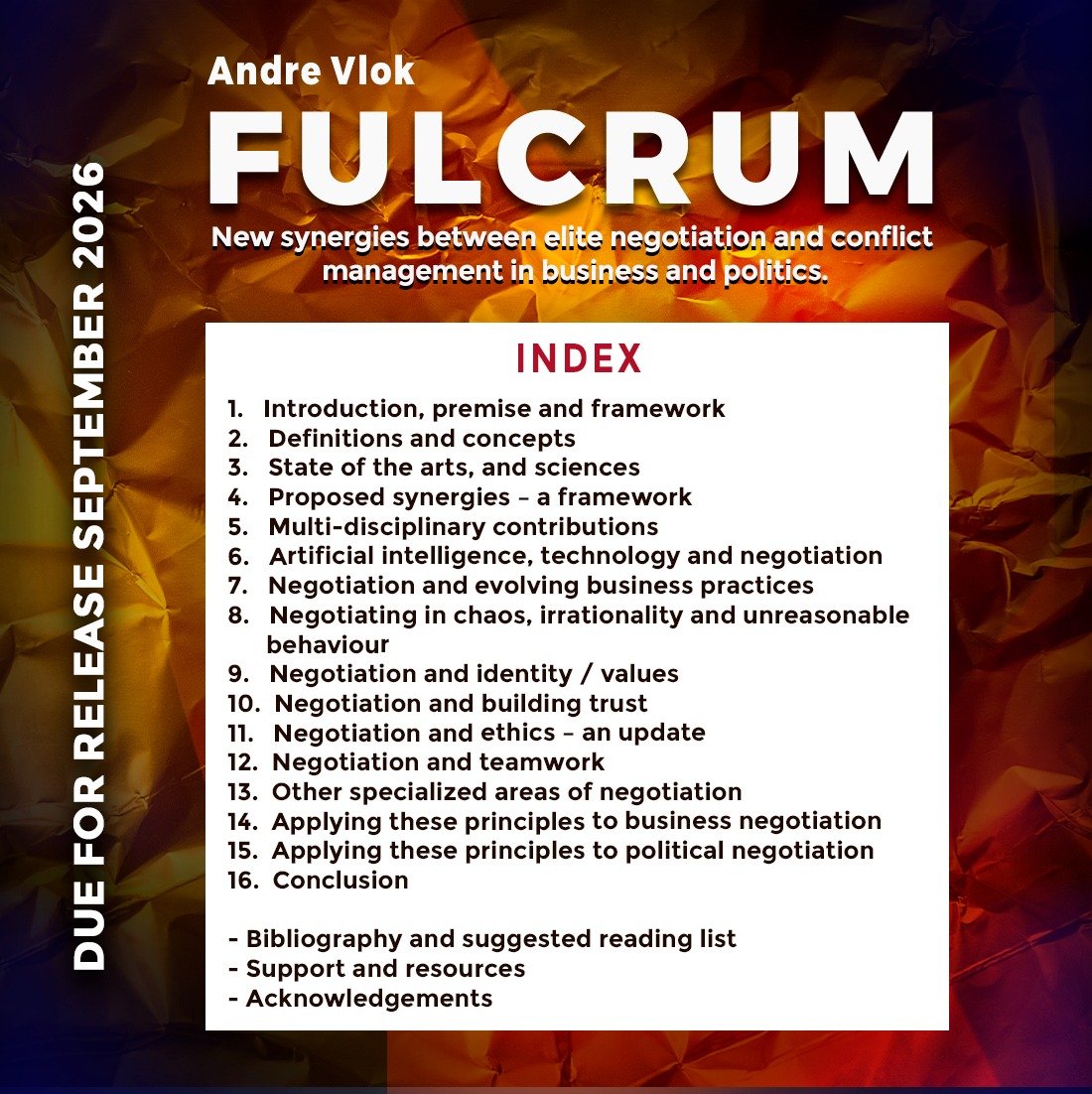
After these comments in Chapter 1, we will in Chapter 2, in the interests of effective communication, clarify a few definitions and concepts that we will be using in the rest of the book. This is kept to the necessary minimum. In Chapter 3 we briefly discuss the state of the art of elite negotiation, as we find it in practice in the commercial and political / diplomatic arenas of our times. We do so to drive an accurate peg in the ground, from which we will measure our progress with the proposed new approaches that we will be studying.
Chapter 4 sets out those proposals: what can we do to implement these changes most productively, and most efficiently, what are our new sources and how do they become grafted on to existing systems, and what framework(s) can we make use of to do so in an organized and structurally sound manner? In Chapter 5 we assess the other disciplines that I propose now form part of the quelle of future elite negotiation development, study and practice. Chapter 6 deals with the essential assessment of the role that artificial intelligence can and should play in our negotiation, with a journey through available tools, their application, and the new potential and options unlocked in this process. Chapter 7 acknowledges the commercial reality that developing global business practices have started leaving conventional negotiations behind, and that we need to do some innovative work here as well.
In Chapter 8 and Chapter 9 we apply what we have studied so far in the book to two selected areas of modern negotiation that illustrate the urgent need for adaptation and new strategies in certain areas of commercial and political negotiation, firstly negotiation in the midst of chaos and disorder, and secondly the crucial need to understand the role of identity conflicts in the evolving art of persuasion. Chapter 10 addresses one of the casualties of recent developments in the methods through which we communicate with each other, and discusses the building, maintaining and restoring of trust in negotiation.
In Chapter 11 we pause to consider an aspect of modern development (AI comes to mind) where development and resultant possibilities often outstrip the ethical underpinning of a particular field, and we ensure that what we are building is placed on solid ethical foundations. In Chapter 12 we deal with the complex work of transferring these new skills to teamwork, which often requires more than just transferring the individual skills to more than one person. As we will see, some of these new approaches require their own nuances and changes when applied in a team environment. The nexus between negotiation and conflict becomes particularly useful here.
In Chapter 13 we then apply what we have studied to the fields of commercial and diplomatic negotiation respectively, including a look at specialised areas of negotiation like supply chain management, trade union negotiation and the negotiation found in litigation. In Chapters 14 and 15 we apply our findings to commercial and political / diplomatic negotiation, including some of the unique political aspects of coalitions. Chapter 16 then gives us the opportunity to assess our work, these new applications and possibilities, and to be specific as far as the actual transformation of our negotiation practices are concerned.
As to footnotes and references, I will follow the popular experiment we used in my earlier books, which balances the need for academic and evidence-based rigor with ease-of-reading, where specific books or links to articles will be found either in a particular chapter itself, at the focused reference section at the end of the chapter, or then the expanded lists of reference material at the end of the book. The chapter on specialized political / diplomatic negotiation (Chapter 15) may of course be skipped in its entirety by the purely commercial negotiator, as it can be viewed as a standalone treatment of the subject, or it can hopefully add a new dimension to those commercial interests, especially as many of those insights translate equally well to the commercial world. The use of power in the political world is of course no stranger to the business world.
At the start of our journey we need to make a few changes in how we view negotiation at the higher levels. We will need to accept, and the evidence will show, that natural negotiation gifts in a person or a team are wonderful gifts, and they often get the job done, but that a negotiating philosophy and strategy based on natural ability, experience in the field or a wing and a prayer are limited, and needlessly reductive.
A knowledgeable, purposefully skilled and naturally gifted negotiator will always outperform a negotiator that must only rely on those natural gifts. Good poker players achieve better results because they study and apply the various odds in play, chess masters expand their natural gifts by hours of study, great musicians improve on their natural talents by practicing what may appear to the lay person to be tedious arrangements of notes, and increasingly, science has shown us that natural ability in any of these endeavours must be augmented by the latest best practices available in that field in order to achieve the outer limits of performance. This we will enable you to do with this book.
The elite negotiator of the immediate future will, as always, have to learn a number of lists and how-to’s in the tried and trusted way, but the heart of the new skill levels will be a deeper understanding of how and why people do what they do, and from there to build a roadmap of skills, tactics and strategies from where we are to where we want to be. The top negotiators will be given building blocks and sent on their way, while the B-team continue to work from lists and info charts.
We will revisit some of these current best practices, and show you a few new strategies, new either in the sense of not having been tried in the field, or tried by a few negotiators without these techniques and strategies having become mainstream yet. I will support the new, or relatively new, strategies with the underlying science and case studies where possible, and you will decide whether some, or all, of these arguments have convinced you to incorporate these ideas into your own practice.
As you will see, some of the discussions we will be having approaches the essence of negotiation, in other words the dissolution of resistance, from rather technical, often even counter-intuitive, directions, and this supports the realization that we are slowly leaving the arena of simply and solely relying on our instincts for elite negotiation results. Those honed, experienced and/or naturally gifted instincts will always be invaluable to us, but they should become informed, supported instincts.
So, as much as we are going to discuss a wide range of disciplines and fields in the process of truly upgrading the field of elite negotiation, this remains ultimately a book about elite negotiation. These other sources are incorporated in our quest to improve elite negotiation to its fullest potential, and for it to be serviceable in allowing us to reach the new challenges and opportunities that we are, and will be, facing.
At the fulcrum of the confluence of these ideas then, we will find the modern elite negotiator. We will notice how this now means that we are no longer able to responsibly work with just a list of “negotiating tips and tricks”, but that we are handed the building blocks of our own tailor-made, industry-specific negotiation machine, and that this will require, demand, increased levels of knowledge and creativity, both now and on an ongoing basis.
It is my prediction that there exists a small window of time, of opportunity, for elite negotiators to use these new strategies in their work before, as always happens with innovation, the rest of the market catches up, and we start finding those “10 Easy Ways to Improve Your Negotiation” lists discussing these developments. A few elite negotiators have already started to push the current boundaries of negotiation, in the commercial or political spheres. We see their work in recent papers or textbooks, or in the field itself. These pioneers I do not need to convince of the benefits, of the necessity, of expanding our work. For them, I simply hope to build on their current understanding by providing a cutting –edge upgraded elite negotiation manual. In this spirit, it is important that we notice both the value and the limitations of building an elite negotiation career on experience alone.
Being experienced in a field of human engagement such as negotiation is a wonderful gift, and it brings with it strategic benefits that money and training cannot duplicate or replace, but it will, with the new approaches to learning and acquiring these skills, always need that extra mile in order to benefit fully from the other advantages that experience brings. Experience, especially in this field, also has its downsides. We become comfortable with our mistakes, we accept self-imposed boundaries, and we tend to not seek current best practices as we could be doing. We start to compare ourselves to how things are in our experience, not against the best in our field.
This book will then seek to integrate the best of these worlds: Experience is what you gain when you engage in a particular behavior (such as negotiation) many times. Expertise is what you gain when you are able to infuse your experience with a “strategic conceptualization” of what you are doing. Unfortunately, many people confuse these two ideas and mistakenly think that their vast experience in negotiation qualifies them as experts.
(Deepak Malhotra, Max Bazerman, Negotiation Genius 341)
I have a further ambition with the book, and that is to light a fire in the heart of the elite negotiator to start incorporating these multidisciplinary strategies and skills into their own negotiating needs and goals. It is a purposeful decision not to expand too much on any given field of discipline and new area of collaboration.
If the selected material we work with in the book convinces you to work at these skills you will need, and want, to expand on our discussion, and if it does not so convince you through the selected material another 300 pages will not do so either. So our discussion, both from design and necessity, merely scratches the surface of what is possible.
To optimize your results, structured, ongoing, deliberate learning is necessary. A very instructive modern negotiation pedagogy is developing, and we can select from these options as we need and wish to invest in from time to time. For my own students I advise a comprehensive upgrade, as a once off exercise, and then regular, disciplined but selected study and practical training on more specialized, industry-specific topics as these develop and become available.
The general experience also seems to indicate that as one grows more comfortable with the process and the results, it becomes easier to select optimal topics or areas of improvement, often of course shaped by developments in your career. Ultimately, and as much as we call it all sorts of other things, negotiation is about the use of power – how to create, shape, use and maintain it. Even in your most collegial, friendly negotiation you are using power – the power to be friendly, accommodating and to compromise, for example – and everything we will be working with is designed to increase your efficiency along those lines.
Our work with identity conflict negotiation, for instance, will reshape your views on power, persuasion and the place of objective facts. I will try to convince you to become comfortable with that power, and we can agree eventually that it need not be something to abuse, that we can use power beneficially, ethically, even compassionately. An important part of of what we will consider will show us how the very idea of power has changed. For all the triumphant return of strongman diplomacy and geopolitical realism is concerned, we are also seeing, in research and in our media, the limits of some of the old conceptualizations of power, and a few intriguing alternatives.
And that use of power leads us to another point of clarification. Negotiation strategies, just like mediation and a few other tools in conflict management, are often presented as little else than alternatives on a list to choose from. I reiterate that this is not what I am asking you to do. These are not alternatives, or fads, or experiments on your account.
These strategies that we will select are superior solutions in the right factual environments, they are presented as the primary solutions, not as this month’s flavour. We should, when pressed to do so, be able to open the hood and explain why this technique is superior. I am pointing out the comfort zone that elite negotiation finds itself in, and then I provide a roadmap out of that trap. The details of how this is translated into the practical realities of your business or other negotiating needs will differ, must differ. We design negotiating and coaching strategies for various businesses, and these programs all show meaningful differences from each other, even in the same industry or profession. I have several clients and students who arrive at the same heights, but their journeys to that exact same spot are radically different. This is as it should be, especially when we understand the processes involved. If you simply apply the strategies and techniques of this book in your negotiating world, you will already be a better elite negotiator, with measurably better results.
If you want to fully integrate the core message of what I am trying to convey, this book is only the beginning of your improvement, of reaching your true, tailor-made potential as an elite negotiator.
Sources and referenced material: Chapter 1
1. “Zombie leadership” and the outdated, debunked fallacies that we continue to believe in. at https://t.co/iojSAmJLaa
2. The November 2025 McKinsey Global Institute report on collaboration potential between humans and artificial intelligence is an enlightening read, and it can be found at at https://t.co/fRXfHF1k56 )
3. Sustained, structured coaching and training is the best methodology in acquiring, developing and maintaining this skill. The following article is recommended as a foundational consideration: https://lnkd.in/eAYzEfwW